Picture yourself sitting beside a fire in the Kunene Region as a Himba elder shows you how ochre paste is made, or crouching in the Kalahari scrub while a San guide reads animal tracks invisible to your untrained eye. Cultural encounters like these are among the most profound experiences Namibia offers, and also the most easily done badly.
Namibia is home to a remarkable mosaic of indigenous communities, each with distinct traditions, languages, and histories. The Himba, San (Ju/'Hoansi), Damara, and Herero are the groups most likely to cross a traveller's path, and all four have established frameworks for receiving visitors, some community-run, some lodge-facilitated. The difference between an experience that genuinely enriches both visitor and host, and one that feels like a performance staged for foreigners, comes down almost entirely to how you book, who you go with, and how you conduct yourself on the day.
This guide, informed by Gotukio's experience working with Namibia specialists and local operators on the ground, gives you a clear picture of each community, where to visit them, what the ethical issues look like in practice, and how to tell a responsible experience from one that isn't.
Namibia's Tribes: A Quick Overview
Namibia has a population of approximately 2.5 million people, and the country is home to a wide variety of ethnic groups, including the Khoi, San, Damara, Nama, Herero, Himba, and Owambo, each contributing to a rich and layered cultural landscape. For travellers, four communities are most accessible and most invested in structured cultural tourism:
Community | Location | Population | Type of Experience |
Himba | Kunene Region (NW Namibia) | ~50,000 | Lodge-facilitated village visits |
San (Ju/'Hoansi) | Kalahari / Grashoek / Tsumkwe | Varied | Community-run Living Museums |
Damara | Near Twyfelfontein (Damaraland) | ~100,000 | Community-run Living Museum |
Herero | Central Namibia / Okahandja | Significant | Town encounters + annual commemoration |
Each has a distinct history with tourism. The Himba have been receiving visitors since shortly after Namibian independence in 1990; the Living Museum model used by the San and Damara is a more structured, community-managed format that has evolved over the past two decades. The Herero are most visible in towns and through their annual Herero Day commemoration rather than formal "village tours." All four communities have chosen to engage with tourism on their own terms, which is the starting point for doing this well.
The Himba: Namibia's Most Iconic Cultural Encounter
Where: Kunene Region, primarily the area north and west of Opuwo, around the Kunene River and Epupa Falls
The Himba inhabit some of Namibia's most rugged terrain, with communities dotting the landscape between the Kunene River and the northern reaches of the Namib Desert. Their population is estimated at around 50,000, and they live primarily in remote villages near Opuwo and Epupa Falls.
The Himba people trace their ancestry to the Herero ethnic group that migrated from central Africa centuries ago. Over time, communities that remained in the arid north developed distinct traditions suited to the harsh Kaokoland climate and the Himba's geographical isolation helped preserve both their population and traditional practices during the devastating German colonial genocide of 1904-1908 that devastated the Herero further south.
The most immediately striking aspect of Himba culture for visitors is the otjize paste, a mixture of ochre and butterfat that women apply to their skin and hair, giving them a distinctive reddish hue. This practice protects against the harsh desert sun and carries cultural and aesthetic significance. Equally important, though less visible to outsiders, is the sacred ancestral fire at the centre of each homestead: the okuruwo, which must never be allowed to extinguish, is the spiritual heart of Himba society and connects the family to its ancestors.
What a Himba Village Visit Actually Looks Like
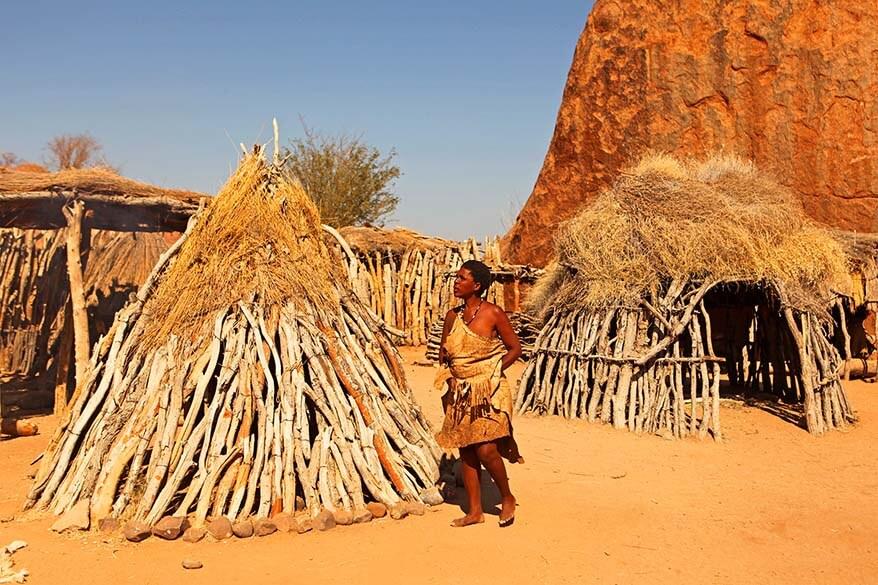
A well-run visit involves arriving with a local guide who speaks the Himba language (OtjiHimba, a dialect of Herero), who will negotiate entry with the village headman and explain what you're seeing in context. You can learn how women's elaborate hairstyles mark different life stages, find out how life differs out in the desert, and understand a lifestyle quite distinct from your own. The visit is conversational rather than performative, which means you're walking into a working homestead, not a stage set.
One critical spatial rule: walking between the sacred fire and the livestock enclosure is a serious act of disrespect to the Himba. Your guide will tell you this, but it's worth knowing before you arrive.
Where to Book a Himba Visit
The most reliable approach is through a lodge in the Kunene Region that has an established relationship with nearby communities. Palmwag Lodge and Grootberg Lodge both offer day trips that include Himba village visits, typically combined with a morning safari drive. The Etendeka Mountain Camp in the same area also has strong reviews for community access.
There is also Omapaha Etosha Himba Village, south of Etosha, which positions itself as a community relocation project rather than a tourist attraction, offering a more accessible (though less remote) option for travellers not making it to the Kunene. Reviews are generally positive, though the experience is less immersive than visiting communities in their traditional territory.
The key quality marker: does your guide speak OtjiHimba? If the answer is no, find a different operator.
Pros
One of Africa's most genuinely preserved indigenous cultures
Community has a long, established relationship with tourism which means they are choosing to welcome visitors
Can be combined with desert elephant tracking and Epupa Falls
Deeply personal and conversational when done properly
Cons
The Kunene Region is remote, it requires significant driving or a fly-in to reach authentic communities
Lower-quality tours exist close to Etosha that are essentially staged for convenience
Photography requires explicit permission (more on this below)
Some visitors find the experience confronting: nudity, very different cultural norms around family structure and marriage
The San (Ju/'Hoansi): The World's Oldest Living Culture
Where: Grashoek (between Grootfontein and Tsumkwe), and Tsumkwe / Nyae Nyae area, northeastern Namibia
The San people are among the oldest continuous cultures on Earth. Genetic research places the ancestors of modern San populations as among the earliest branches of the human family tree. In Namibia, the Ju/'Hoansi San of the Nyae Nyae region are the most accessible for visitors, and they've built one of the most respected cultural tourism models in Africa.
The Living Museum of the Ju/'Hoansi-San at Grashoek is the first Living Museum in Namibia. Run entirely by the Ju/'Hoansi community since July 2004, it functions as both a cultural school for San children and a community business. This is important: it's not a heritage attraction managed by outsiders. The San themselves decide what is shared, who participates, and how revenue is distributed.
What Happens at the Living Museum
Visitors can participate in a bushwalk where guides demonstrate fire-making, tracking, and hunting skills, as well as storytelling sessions recounting ancestral legends and desert survival techniques. The programme is highly interactive, visitors try to shoot a bow, attempt San rope-skipping, and participate in traditional songs.
At the Tsumkwe Living Hunter's Museum (a separate site currently being re-established following community disagreements at the previous location), the San of the Nyae Nyae Conservancy are the only group officially permitted to still hunt traditionally and tracking demonstrations and participation in a traditional hunt are the focal experience.
A key detail worth knowing: the term "Bushmen" is still used on many signboards and tour descriptions in Namibia, but the community themselves prefer "San." Use San in conversation.
Living Museum Logistics
Location: Grashoek Living Museum is about halfway between Grootfontein and Tsumkwe, north of the C44
Pre-booking: Not possible at Grashoek, you arrive and pay at reception
Accommodation: Basic campsite adjacent to the museum
Duration: Half a day is standard; a full day is better; overnight is available
The drive to Tsumkwe is long and the road quality is variable, factor 4WD into your planning if you're going deep into Bushmanland.
Pros
Community-owned and operated with direct income distribution
Genuinely interactive, not a performance, a shared experience
Children are naturally integrated, giving an authentic picture of family life
One of the most commented-on highlights on Namibia itineraries
Cons
Remote, the best experiences require significant travel off main routes
Not suitable as a quick half-day add-on to a busy Etosha itinerary
The Living Hunter's Museum near Tsumkwe is currently in transition (as of 2026) check current status before planning around it
Roads to Tsumkwe are slow going and not suitable for standard rental cars
The Damara: The Living Museum Near Twyfelfontein
Where: About 10km north of Twyfelfontein, Damaraland
The Damara are one of the oldest peoples in Namibia. Their original culture blended hunter-gatherer traditions with herding of cattle, goats, and sheep. During the colonisation of Namibia, the Damara's relatively loose social structures made it difficult to defend against aggressors, and much of their traditional culture was lost as a result. The Damara Living Museum is essentially a conscious recovery effort, an attempt to reconstruct and keep alive a culture that came close to disappearing.
The Living Museum near Twyfelfontein is the first traditional Damara project in Namibia and the only one of its kind in the world. It opened in 2010 and is run under the auspices of the Living Culture Foundation Namibia (LCFN), the same organisation that oversees the San Living Museums.
What Happens at the Damara Living Museum
There are three programme options. The village programme (N$130 per person) covers daily traditional life: blacksmithing, leather tanning, jewellery and crafts, dancing, singing, and fire-making. The bush programme (N$110 per person) follows women foraging for plants used as food, perfume, and medicine, while men demonstrate trap-setting and traditional hunting. The combined programme (N$220 per person) covers both. A separate village visit to the Damara's modern home village, Louw-In, is also available.
Practical note: Reviews are mixed on the bush walk. Some visitors find it excellent, others feel it's brief. The village programme consistently receives stronger feedback. Combine the Damara Living Museum with the Twyfelfontein rock engravings (UNESCO World Heritage Site, 270 NAD entry in 2026) for a full day in the area.
Pros
Easily combinable with Twyfelfontein, Burnt Mountain, and Organ Pipes
Very affordable entry prices with direct community income
Unusual, Damara cultural heritage is less widely documented than Himba or San
No advance booking required
Cons
Shorter and more structured than the San Living Museum experience
Some reviewers note the modern village context makes the "traditional" framing feel slightly artificial
Limited immersion, it's a few hours, not an overnight
The Herero: Resilience Worn on the Body
Where: Central Namibia, particularly Okahandja and Windhoek; visible throughout the country
The Herero story is, in many ways, the darkest chapter in Namibian history. In the early 20th century, the Herero faced severe repression during the German colonial period, what historians now widely recognise as one of the first genocides of the 20th century. Today the Herero continue to honour their ancestors through annual commemorations and by preserving their cultural practices.
What visitors most immediately notice is the clothing. Herero women wear Victorian-style dresses with wide-brimmed horn-shaped headpieces, a style adopted during the German colonial period that has since been reclaimed as a powerful symbol of cultural pride and survival. Seeing Herero women in their full dress in Windhoek or Okahandja is striking and entirely everyday, this is not performance.
Herero Day: Okahandja, August 23rd
Herero Day takes place on August 23rd (or the nearest Sunday) in Okahandja. This poignant commemorative event marks the 1904 Battle of Waterberg, with parades of warriors dressed in striking traditional attire honouring fallen heroes. This is one of the most significant cultural events in Namibia and is open to respectful visitors. If your trip falls in August, it's worth considering Okahandja as a stop.
Unlike the Himba, San, and Damara, the Herero don't have a formal village-visit tourism structure. The Herero encounter for most travellers is organic, in towns, at markets, at the Okahandja woodcarvers' market (one of the best craft markets in Namibia), and through cultural events.
Ethical Cultural Tourism in Namibia: What It Actually Means
At its best, cultural tourism in Namibia offers an authentic insight into some of the world's most unique ways of life, while giving those communities a sustainable source of income and a way to celebrate and keep their customs alive. At its worst, tours to tribal villages and townships can feel akin to visiting a human zoo.
The gap between those two experiences is not usually about intent, most travellers visiting Namibia genuinely want respectful, meaningful encounters. The gap is about structure: who controls the visit, who benefits financially, and whether the community has genuine agency over what happens.
Here are the questions to ask before booking any cultural experience in Namibia:
1. Does the community benefit directly? Living Museums are run by communities and keep the revenue. Lodge-facilitated Himba visits should include a payment to the village, not just a fee to the lodge. Ask explicitly: "What goes to the community?"
2. Does the guide speak the community's language? A guide who doesn't speak OtjiHimba cannot properly facilitate a Himba visit. A guide who doesn't speak Ju/'Hoansi will miss most of what an elder is saying. This is non-negotiable.
3. Does the community control the access? In the best experiences, the village headman or community manager decides whether the visit happens, when, and for how long. If an operator is "guaranteeing" access regardless of community preference, something is wrong.
4. How many visitors are there? Large group tours to small communities are inherently more extractive and less personal. Small groups (two to eight people) are the gold standard.
5. Is this the community's actual home, or a show village? Some operators run "Himba villages" close to Etosha or Windhoek that were established specifically for tourism, populated by Himba who have relocated to be closer to tourist routes. These are not without value, but they are not the same as visiting a community living on its ancestral land.
The "Human Zoo" Problem and How to Avoid It
The phrase "human zoo" appears frequently in discussions of tribal tourism in Namibia, and for good reason. It describes the dynamic where visitors arrive, look at people as if they were exhibits, take photographs, and leave without any genuine exchange. It's extractive for the visitor (who gets a shallow experience) and dehumanising for the community.
The antidote is not to avoid cultural visits but to approach them differently.
The best memories from cultural tours come from genuine exchange. Step out from behind your camera, enter a Himba hut when invited, and ask questions about your hosts' lives. They'll be fascinated to hear more about you too, sharing your own stories is what makes the experience mutual.
Concrete things that shift the dynamic:
Ask your guide to teach you a few words in the local language. Attempting a click consonant in Damara or San languages will get a laugh and immediately warm the room.
Participate rather than observe: Make the fire, try to string the bow, attempt the step.
Buy directly from craftspeople when given the opportunity. The craftshop at the Ju/'Hoansi Living Museum in Grashoek sells ostrich jewellery and traditional items. Buying there puts money directly in the hands of the person who made it.
Ask questions that show genuine curiosityL about what younger community members do, about how they feel about the tensions between traditional life and modern Namibia, about what they want visitors to understand about their culture.
Photography Rules You Must Know Before You Visit
Photography is the most contentious issue in Namibia's cultural tourism space, and mishandling it has serious consequences, both interpersonally and legally.
General rules:
Always ask before photographing anyone. This is true everywhere, but particularly critical here.
If someone says no, that's the end of it. No negotiating, no "just one quick shot," no photographing from a distance assuming they won't notice.
Never photograph children without explicit parental consent. This rule is absolute. In May 2025, a British tourist visiting the Ju/'Hoansi Living Museum in Grashoek was arrested and faced 38 charges including indecent assault and child trafficking after allegedly photographing minors without consent. This is an extreme case, but it illustrates how seriously Namibian authorities and communities treat this issue.
At some Himba communities, a photography fee is standard, typically a small amount paid to the individual or family being photographed. This is not a tourist trap; it's a reasonable exchange for someone letting you document their life.
Photographing the sacred fire at a Himba homestead is typically not permitted. Follow your guide's lead.
The simplest approach: put the camera away for the first half of the visit. Build the relationship first. If the moment for a photograph comes naturally, you'll know it and if you ask then, the answer is much more likely to be yes.
What to Bring and What to Leave Behind
Bring:
Small gifts for children are often welcome: crayons, pencils, and school supplies are more useful than sweets. Ask your operator in advance what's appropriate for the specific community.
Cash in small Namibian dollars for craft purchases and photography fees
A hat, sunscreen, and water as visits in the Kunene can run several hours in significant heat
Closed-toe shoes or sturdy sandals as you'll be walking on rocky, uneven ground
A notebook and genuine curiosity
Leave behind:
Assumptions. Himba women who are bare-chested in traditional dress are not in any way inviting comment or the kind of attention some visitors unfortunately direct at them.
Excessive camera equipment. A phone or a small camera is appropriate. A drone is not, ask your operator first and expect the answer to be no.
Items you plan to "give away" without local operator guidance. Well-intentioned gifts of clothing or food can disrupt community dynamics in ways that aren't immediately visible. Talk to your guide first.
Any expectation that this experience should look like what you saw on Instagram. Real cultural visits are uneven, sometimes slow, occasionally logistically awkward. That's what makes them real.
How to Book a Cultural Visit in Namibia
There are three reliable approaches to booking cultural experiences in Namibia:
1. Lodge-facilitated (Himba, primarily) Book a lodge in the Kunene Region: Palmwag, Grootberg Lodge, Etendeka Mountain Camp and request a Himba village visit as part of your programme. The lodge has pre-existing relationships with communities and a guide who speaks OtjiHimba. This is the best option for Himba visits.
2. Living Culture Foundation Namibia (San and Damara) The LCFN operates seven official Living Museums across Namibia, including the Ju/'Hoansi San Living Museum in Grashoek and the Damara. Living Museum near Twyfelfontein. These are walk-in, no-advance-booking experiences: you arrive, pay the entry fee, and the community manages the rest. The LCFN is a German-Namibian non-profit that has been supporting these museums since the early 2000s and is the most credible framework for San and Damara cultural visits in the country.
3. Specialist Namibia operator For a trip that integrates cultural visits into a broader Namibia itinerary, a specialist operator who knows which Himba communities are genuinely welcoming visitors (this changes seasonally, as the Himba are semi-nomadic), which Living Museums are currently operational, and how to sequence a cultural-wildlife hybrid route is the most efficient path.
Gotukio's trip planner is not yet updated for Namibia, but our team works with vetted in-country specialists across Namibia. Book a call with us and we'll plan your Namibia trip from scratch, including cultural visits that are ethically structured and logistically sound. Book a call with Gotukio →
Frequently Asked Questions
Is it ethical to visit Himba communities in Namibia?
Yes, when done correctly. The Himba have a longstanding relationship with tourism and visiting a settlement is considered one of the best cultural experiences in Namibia, but the key is using a guide who speaks the Himba language, ensuring the community receives payment directly, and approaching the visit as a genuine exchange rather than observation. Poorly structured Himba tourism does exist, particularly in convenient but inauthentic "show villages" near Etosha. The solution is to go to the Kunene Region and book through a lodge with established community relationships.
What is a Living Museum and how is it different from a village visit?
A Living Museum is a community-operated open-air space where members of an indigenous community demonstrate and share their traditional knowledge and practices with visitors. The Ju/'Hoansi Living Museum in Grashoek is the first in Namibia, and has been run independently by the San since 2004. It functions as both a cultural school for San children and a sustainable community business. The key difference from a standard village visit is that the community controls everything, the programming, the access, and the revenue, rather than an outside tour operator or lodge.
Can I take photographs during a tribal visit in Namibia?
Only with explicit permission, always. Ask before every photograph. For children, parental consent is required and the answer may simply be no. Some Himba communities charge a small photography fee, which is entirely reasonable. A May 2025 incident at the Grashoek Living Museum, in which a tourist was arrested after photographing children without consent, resulted in serious criminal charges. Photography violations are taken very seriously by both communities and Namibian authorities.
How much does a cultural visit cost in Namibia?
It varies significantly. The Damara Living Museum charges N$110–220 per person (roughly £5–11 at 2026 exchange rates) depending on the programme. The Ju/'Hoansi Living Museum is similarly priced. A lodge-facilitated Himba visit in the Kunene will typically cost more, often included in a day activity rate from the lodge, which might be in the USD 80–150 range per person. All of this is extremely reasonable for the depth of experience on offer. Budget accordingly, and buy crafts.
Is the Himba culture endangered?
Not in a straightforward sense. Many younger Himba have attended boarding schools in towns and can compare two very different lifestyles, modernity is present and known. But the community's semi-nomadic pastoral lifestyle faces real pressure from climate change, land rights disputes, and the pull of urban employment. Responsible tourism that generates income for remote Himba communities gives them a genuine economic reason to stay on ancestral land. It is, in that sense, part of what makes cultural preservation possible rather than a threat to it.
Can I combine cultural visits with wildlife safaris in Namibia?
Yes, and in fact the two work very well together in the Kunene. A stay at Palmwag or Grootberg Lodge gives you access to desert-adapted elephants and black rhino tracking in the morning and a Himba village visit in the afternoon (or vice versa). The Damara Living Museum near Twyfelfontein sits within easy reach of Damaraland's famous desert wildlife. And the route to the San Living Museum in Grashoek can be woven into a loop that also takes in Etosha National Park.
Do I need to speak any local languages to visit?
No, your guide translates. But learning a few words matters enormously in terms of how warmly you're received. Ask your guide to teach you a basic greeting in OtjiHimba (for Himba visits) or to show you a click consonant in San or Damara. Making the attempt, however badly, is one of the most effective ways to signal genuine respect and curiosity.
Is Namibia safe for independent travellers doing cultural visits?
Yes. Namibia is one of the safest countries in sub-Saharan Africa for international travellers, and the cultural tourism framework is well-established. The risks around cultural visits are mostly about doing them poorly, going without a guide, showing up at communities unannounced, mishandling photography, rather than any safety threat. For the Kunene Region, the roads are remote and 4WD is essential; plan your fuel carefully and carry emergency provisions for any breakdown.
Planning a Namibia trip that includes cultural encounters alongside wildlife and landscapes? Our Namibia trip planner is in development, but our team can build your itinerary now. Book a free call with us and we'll work with our in-country Namibia specialists to plan the right trip for you. Get in touch →
Join the GoTukio Travel Club!
Receive exclusive inspiration and deals for your next trip.