
Picture this: you've finally arrived at Africa's most famous wildlife reserve, and your game drive to see a cheetah kill grinds to a halt because 87 safari vehicles have already circled the sighting. That's not a hypothetical, it's a documented reality at the Masai Mara during peak season, and in 2025 it got bad enough to spark serious conversations about whether the reserve is becoming a victim of its own fame.
The Masai Mara is still spectacular. If you want the Great Migration river crossings between July and October, there is genuinely no substitute, but for everyone else: the traveller who wants space, silence, rare wildlife, and a game drive where you're one of three vehicles at a sighting rather than one of a hundred, Kenya has some seriously underrated options.
This guide covers the four best Masai Mara alternatives in Kenya, why each one deserves a slot on your itinerary, and exactly how to structure your trip. These recommendations are informed by Gotukio's experience booking Kenya safaris and input from our ground operator partners across the country.
Why Consider Skipping the Masai Mara?
The honest case for skipping the Mara isn't that it's bad, it's that for many travellers, the experience no longer delivers what they came for.
During peak migration season (July to October), vehicle counts at popular sightings regularly hit 60, 80, or more. There's a well-documented case from 2025 where a guest counted 87 vehicles at a single Mara River crossing. A viral video that same year showed cheetahs completing a kill while dozens of Land Cruisers closed in within minutes. These aren't freak incidents, they're the Mara in high season. A 2025 scientific study using a decade of Mara lion data found that lion densities are measurably lower in areas with higher tourist camp concentrations, and earlier research linked heavy vehicle crowding to reduced cheetah cub survival rates.
Then there's the cost: the Masai Mara charges $100 per person per day in low season and $200 per person per day in peak season, making it one of the most expensive public reserves in East Africa, before a single night's accommodation is factored in. In July and August, when demand peaks, popular conservancy lodges surrounding the reserve sell out 12 months in advance.
The migration crossings that draw 90% of peak-season visitors are entirely unpredictable. You could spend four nights at the river and never see a crossing, or you could arrive on a Tuesday afternoon and watch 3,000 wildebeest go in 45 minutes.
So who should consider alternatives?
Travellers visiting between November and June, when the migration is in Tanzania
Anyone prioritising intimate game drives with few other vehicles
Photographers who want clean sightings without a ring of Land Cruisers
Travellers interested in rare or endemic species not found in the Mara
Anyone combining Kenya with other East African destinations and tight on days
Budget-conscious travellers watching the per-person park fee bill
The Four Best Kenya Safari Alternatives to the Masai Mara
Destination | Best For | Park Fee (Non-Resident) | Crowds | Wildlife Highlight |
Amboseli NP | Elephants, Kilimanjaro photography | ~$90/adult/day | Low– Medium | Largest free-roaming elephant herds in Kenya |
Samburu NR | Rare endemic species, northern Kenya | ~$85/adult/day | Low | The Samburu Special Five |
Tsavo East & West | Wilderness, red elephants, value | ~$80/adult/day | Very Low | Red-dusted elephants, Mzima Springs |
Laikipia Plateau | Rhinos, conservancy experiences, activities | $90–110/adult/day | Very Low | Home to 50%+ of Kenya's black rhinos |
Amboseli National Park: Elephants and Kilimanjaro
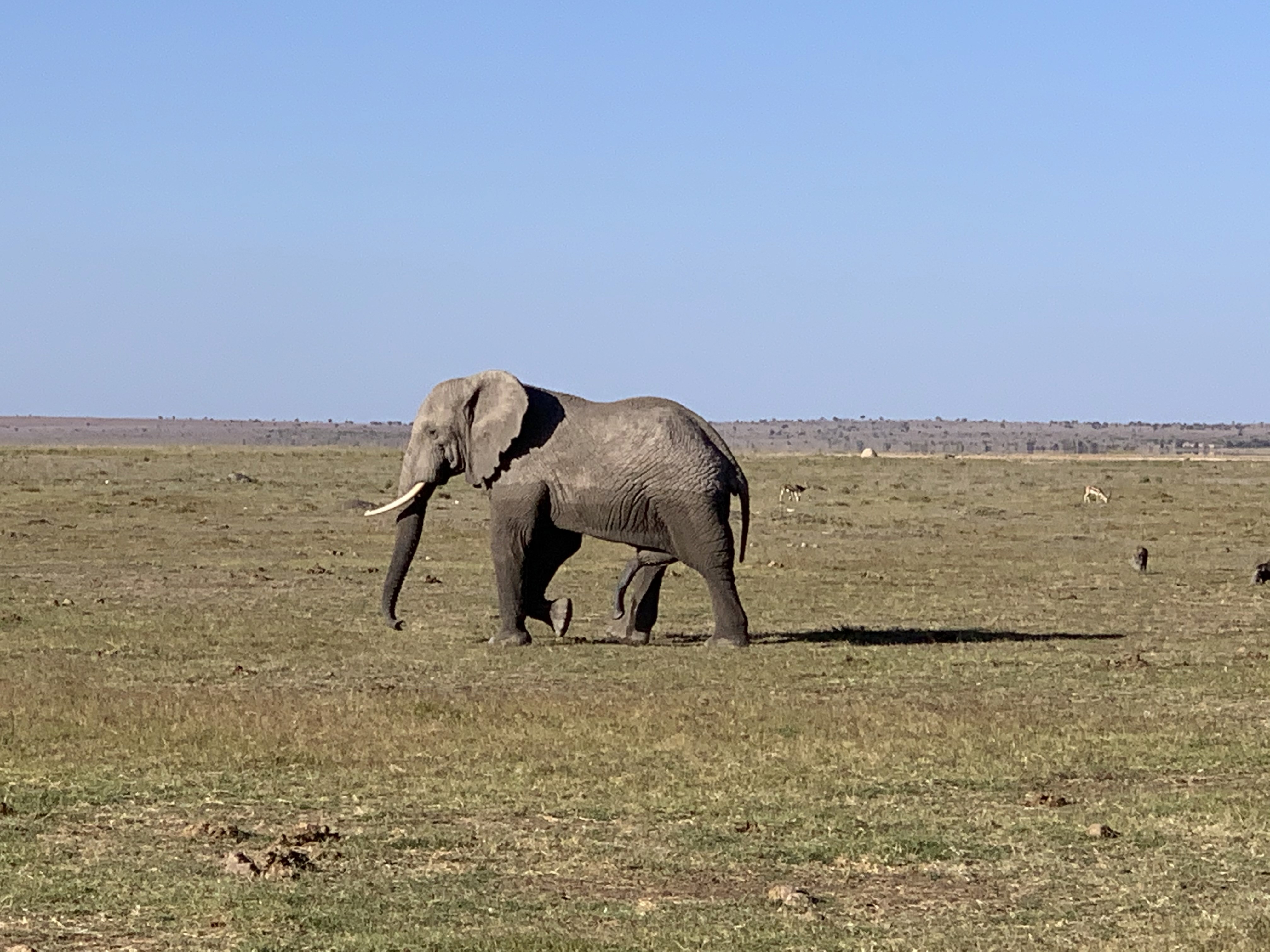
Amboseli is Kenya's second most-visited park, but "second" is relative as it sees a fraction of the Mara's footprint and delivers one of the most visually distinctive safari experiences on the continent. The park's big draw is its elephant population: large, habituated herds with some of Africa's biggest tuskers, moving in the shadow of Mount Kilimanjaro. On a clear morning, watching a hundred elephants cross a dusty plain with Africa's highest peak filling the sky behind them is the kind of image that defines safari photography.
Amboseli sits at the foot of Kilimanjaro, about 240 km from Nairobi which a 4-hour road transfer or a 45-minute charter flight. At just 392 km², it's compact enough to cover thoroughly in 2 to 3 nights, which makes it an efficient addition to any Kenya itinerary.
What makes Amboseli different from the Mara:
The ecosystem is built around swamps fed by underground water from Kilimanjaro's snowmelt, creating permanent wetlands that attract enormous concentrations of wildlife year-round. Unlike the Mara, where game viewing peaks in the dry season, Amboseli offers consistent, reliable wildlife throughout the year. The park doesn't have the predator density of the Mara or Samburu, but elephant sightings, often at close range and in huge family groups, are virtually guaranteed every day.
Key wildlife: Elephants, lions, cheetahs, leopards, buffalo, hippos, wildebeest, zebra, and exceptional birdlife including pelicans, flamingos, and kingfishers around the swamps.
2026 park entry fee: ~$100 per adult per day for non-residents (flat rate, no seasonal pricing)
Recommended time: 2 to 3 nights. Three nights gives you six game drives and time for a Maasai village visit.
Best lodges: Tortilis Camp (mid-range/luxury), Ol Tukai Lodge (mid-range), Amboseli Serena Safari Lodge (mid-range), Amboseli Sopa Lodge (budget-friendly mid-range).
Samburu National Reserve: Kenya's Wild North
If there's one park in Kenya that consistently surprises first-time visitors, it's Samburu. Located about 350 km north of Nairobi in the semi-arid foothills of northern Kenya, the reserve sits on the banks of the Ewaso Ng'iro River and delivers an experience that looks and feels nothing like the Mara's open grasslands.
The case for Samburu rests on a single compelling fact: it's home to five species you won't find in any other Kenyan park. The "Samburu Special Five" reticulated giraffe, Grevy's zebra, Somali ostrich, gerenuk, and Beisa oryx are found only in the arid north, and seeing all five in a single game drive is a routine morning in Samburu. For travellers who've already done a Big Five safari, Samburu offers a genuine second chapter.
Beyond the endemic species, Samburu has a strong Big Cat population. Leopard sightings along the riverbanks are frequent, lions are resident, and wild dogs, one of Africa's most endangered predators, make occasional appearances. Elephant numbers are also significant; the Ewaso Ng'iro River draws large herds during the dry season.
The landscape itself earns its keep. Volcanic hills, doum palms, and the ribbon of green along the river set against a backdrop of rust-red soil give Samburu a visual drama that you simply don't get in the south, a nd crucially: very few vehicles. On a typical morning game drive in Samburu, you might encounter two or three other vehicles at a major sighting. In the Mara in August, you'd be one of 80.
Key wildlife: Reticulated giraffe, Grevy's zebra, gerenuk, Beisa oryx, Somali ostrich, leopard, lion, elephant, cheetah, wild dog.
2026 park entry fee: ~$85 per adult per day for non-residents (flat rate, no seasonal pricing)
Getting there: 5-6 hour road transfer from Nairobi, or a 1-hour charter flight from Wilson Airport. Most operators fly guests in and drive them out (or vice versa) to take in the northern landscape.
Recommended time: 3 nights. Four nights lets you cover Samburu, Buffalo Springs, and a half-day at Reteti.
Best lodges: Sasaab (Luxury), Saruni Samburu (luxury), Elephant Bedroom Camp (luxury), Ashnil Samburu Camp (mid-range), Samburu Simba Lodge (mid-range).
Tsavo East and West: Kenya's Largest Wilderness
Together, Tsavo East and Tsavo West form the largest national park in Kenya at over 20,000km², bigger than Wales. Very few safari travellers from outside Kenya have Tsavo on their radar, which is baffling given what it offers: enormous elephant herds, dramatic landscapes, strong predator populations, and among the lowest vehicle densities of any major Kenyan park.
Tsavo East is the easier of the two to navigate and consistently delivers better wildlife visibility. The terrain is open savannah with scattered acacia, and the park's most famous residents are its red elephants herds that dust-bathe in the iron-rich red laterite soil until they take on a rusty-orange hue. It's one of Africa's most distinctive wildlife sights. The Galana River provides a permanent water source that draws hippos, crocodiles, and large elephant herds, and Mudanda Rock, a natural dam that acts as a water catchment, is one of the best game-viewing vantage points in Kenya.
Tsavo West is more dramatic in terms of scenery. The Mzima Springs which is a crystal-clear natural oasis where hippos and crocodiles live in translucent volcanic water, is one of Kenya's genuine natural wonders. The park also has the Shetani lava flows, a striking black volcanic landscape that looks almost Martian, and the Ngulia Rhino Sanctuary for black rhino conservation. Tsavo West is denser and more wooded, which makes sightings slightly harder but the landscape more visually arresting.
Both parks share the same park fee structure, and both represent exceptional value compared to the Mara, a flat $80 per adult per day with no peak season surcharge.
Tsavo also makes compelling logistical sense for travellers flying into Mombasa rather than Nairobi. The park sits roughly between Nairobi and the coast, making a Nairobi → Tsavo → Diani Beach routing genuinely practical for a 7–10 day trip.
Key wildlife: Red elephants (one of the largest elephant populations in East Africa), lions, leopard, cheetah, black rhino, hippo, crocodile, buffalo, gerenuk, lesser kudu, 500+ bird species.
2026 park entry fee: ~$80 per adult per day for non-residents (flat rate, both parks)
Recommended time: 2 nights in Tsavo East, 2 nights in Tsavo West for a combined experience. You can do Tsavo East alone in 2 nights.
Best lodges: Finch Hattons (luxury, Tsavo West), Kilaguni Serena Safari Lodge (mid-range, Tsavo West), Satao Camp (mid-range, Tsavo East), Ashnil Aruba Lodge (mid-range, Tsavo East).
Laikipia Plateau: Kenya's Best Conservancy Safari
The Laikipia Plateau is not a national park. It's a patchwork of private ranches, community conservancies, and wildlife sanctuaries covering over two million acres on the slopes of Mount Kenya and the Aberdares and it is, arguably, Kenya's most exciting safari destination for the kind of traveller who wants more than a game drive.
Laikipia's model is what serious conservationists point to as the template for the future of African wildlife protection. Tourism revenue funds everything directly: ranger salaries, anti-poaching operations, community schools and healthcare, water infrastructure, and the ongoing expansion of wildlife habitat. Ol Pejeta Conservancy alone covers nearly its entire $6 million annual operating budget through safari tourism.
In wildlife terms, Laikipia's headline statistic is the one that stops people mid-sentence: the plateau hosts more than 50% of Kenya's entire black rhino population. Ol Pejeta is the largest black rhino sanctuary in East Africa, and it's also the last refuge of the world's only two remaining northern white rhinos Najin and Fatu, whose survival depends on an ongoing IVF programme being conducted on-site.
Beyond rhinos, Laikipia conservancies offer activities simply not available in national parks: night game drives, guided bush walks, horseback safaris, mountain biking through wildlife, and community visits are standard inclusions at most camps. Off-road driving is permitted in most conservancies, which changes the game entirely for cat sightings. Cheetah and wild dog tracking on foot is possible.
Ol Pejeta is the most accessible entry point (3-4 hours from Nairobi by road, or a 45-minute charter flight to Nanyuki). Lewa Wildlife Conservancy is a UNESCO World Heritage Site immediately adjacent and offers some of Kenya's finest luxury lodges. Borana, Loisaba, and Sosian are further north and increasingly exclusive as you go.
Key wildlife: Black and white rhinos (including the world's last northern whites), elephant, lion, cheetah, leopard, Grevy's zebra, African wild dog, reticulated giraffe, buffalo.
2026 conservancy fees: ~$110 per adult per day at Ol Pejeta; conservancy fees at private lodges typically run $80-150 per person per night on top of accommodation
Getting there: Nanyuki, the gateway town, is 3-4 hours from Nairobi by road or 45 minutes by charter from Wilson Airport.
Recommended time: 3-4 nights across one or two conservancies.
Best lodges: Sweetwaters Serena Camp (mid-range, Ol Pejeta), Ol Pejeta Bush Camp (mid-range), Loisaba Tented Camp (luxury), Maisha Sweetwaters (mid-range).
How Much Do These Alternatives Cost vs. the Masai Mara?
One of the strongest practical arguments for Mara alternatives is the cost difference, particularly in peak season.
Park | Non-Resident Entry Fee | Peak Season Surcharge? | Mid-Range Package (per person/day) |
Masai Mara (Jul–Oct) | $200/day | Yes (+100%) | $600–$900 |
Masai Mara (Jan–Jun) | $100/day | No | $450–$700 |
Amboseli | ~$90/day | No | $400–$650 |
Samburu | ~$85/day | No | $400–$650 |
Tsavo East/West | ~$80/day | No | $300–$550 |
Laikipia (Ol Pejeta) | ~$90–110/day | No | $500–$800 |
The Tsavo parks represent exceptional value with flat fees year-round, no seasonal surcharge, and mid-range packages that run $100-300 per person per day cheaper than the Mara in high season. Samburu and Amboseli sit in the same ballpark as the Mara in low season but deliver a less crowded experience at the same price point.
Laikipia conservancies are at the premium end, but what's included justifies it: night drives, walking safaris, horseback options, and conservancy fees that directly fund one of Africa's most credible conservation programmes.
Best Time to Visit Each Alternative
One major advantage of these destinations: none of them suffer the Mara's crowd-peak in July-October. Three of the four are strong year-round options.
Month | Amboseli | Samburu | Tsavo East/West | Laikipia |
January | Excellent | Good | Excellent | Good |
February | Excellent | Good | Excellent | Good |
March | Good | Good | Good | Good |
April | OK | Good | OK | OK |
May | OK | Good | OK | OK |
June | Good | Excellent | Good | Excellent |
July | Excellent | Excellent | Excellent | Excellent |
August | Excellent | Excellent | Excellent | Excellent |
September | Excellent | Excellent | Excellent | Excellent |
October | Excellent | Excellent | Excellent | Excellent |
November | Good | Good | Good | Good |
December | Excellent | Good | Excellent | Good |
Sample Kenya Safari Itineraries Without the Masai Mara
7-Day Kenya Safari: Amboseli + Tsavo East
Best for: First-time Kenya visitors, photography enthusiasts, travellers combining with the coast, value seekers.
Overview: This is Kenya's most accessible non-Mara circuit. You get the iconic Kilimanjaro elephant photography in Amboseli, followed by the raw wilderness and red elephants of Tsavo East. The route ends near the coast, making it perfect if you're adding a few days on Diani Beach.
Day 1: Arrive Nairobi → Amboseli
Fly into Nairobi (JKIA) and transfer by road to Amboseli, around 4 hours via the Namanga road. You'll arrive in time for an afternoon game drive, which is an excellent introduction: the light on Kilimanjaro is best in the late afternoon and your first elephant herd is almost guaranteed within the first hour. Overnight at Amboseli Serena Safari Lodge or Tortilis Camp.
Day 2: Amboseli
Two full game drives today. A dawn drive takes you out to the swamp areas for elephant and bird activity at first light. Mid-morning, consider a guided walk with a Maasai ranger from the park boundary, an underrated experience that most visitors skip. Your afternoon drive focuses on the open plains southeast of Observation Hill, one of the best predator corridors in the park. Keep Kilimanjaro on the horizon.
Day 3: Amboseli → Tsavo West
After a morning game drive, depart for Tsavo West, roughly 3 hours east via the Amboseli-Tsavo corridor. Check in at your Tsavo West lodge in time for a late afternoon drive to Mzima Springs. Spend 30 minutes at the underwater viewing chamber watching hippos move in the crystal water. If luck holds, your guide might position you near the pool at dusk when the big crocodiles become active. Overnight at Finch Hattons or Kilaguni Serena.
Day 4: Tsavo West
Morning drive through the Chyulu Hills ecosystem, a dramatically scenic lava landscape that gives Tsavo West its distinctive feel. The Shetani lava flows are a 20-minute drive from most central camps and worth 45 minutes on foot with a ranger guide. Afternoon drive along the Tsavo River corridor, where lions concentrate in the dry season. Tsavo West has a strong leopard population and your guide will know the current territories. Overnight Tsavo West, choose Salt Licks for a unique experience.
Day 5: Tsavo West → Tsavo East
Cross through the Mtito Andei gate linking the two parks and transfer to Tsavo East. The transition between the two parks is visually striking as you go from Tsavo West's bushy volcanic terrain into Tsavo East's open, dusty savannah within 30 minutes. Check into your Tsavo East camp and take an afternoon drive to the Galana River, where pods of hippo and large crocodiles are virtually guaranteed. Overnight at Satao Camp or Ashnil Aruba.
Day 6: Tsavo East
Full day in Tsavo East. Morning drive targeting the red elephants, head for Mudanda Rock, where a natural dam creates a gathering point for huge elephant herds, sometimes 200 or more at a time. This is one of the most dramatic wildlife spectacles in Kenya and barely anyone knows about it. Afternoon drive along the Voi River looking for lions. Tsavo East has one of Kenya's largest lion populations, and the open terrain means sightings are often long and undisturbed by other vehicles.
Day 7: Tsavo East → Mombasa / Fly Home
Final morning drive, then transfer to Mombasa (roughly 2 hours) for an international flight, or continue south to Diani Beach for a 3-night coast extension.
Estimated cost (excluding international flights): $2,800-$4,500 per person (mid-range), $5,500-$8,500 (luxury)
8-Day Kenya Safari: Samburu + Laikipia (Ol Pejeta + Lewa)
Best for: Returning Kenya safari visitors, rhino enthusiasts, photographers, travellers wanting activity variety beyond game drives.
Overview: This is a northern Kenya circuit that most international travellers never consider and it's genuinely one of the best safari itineraries in East Africa. You start in Samburu for endemic species and leopard sightings, then move south to Laikipia for rhinos, conservancy activities, and the most intimate game drives available in Kenya. No Mara crowds, no seasonal constraints, no park fee surcharges.
Day 1: Arrive Nairobi → Samburu
Charter flight from Wilson Airport to Samburu (roughly 1 hour, much better than the 5–6 hour road). Afternoon game drive along the Ewaso Ng'iro riverbank. Samburu rewards early arrivers: elephant herds come to the river in the afternoon heat, and leopards are often spotted in the doum palms before sunset. Overnight at Elephant Bedroom Camp or Sasaab.
Day 2: Samburu
Full day with two game drives. A morning drive to spot the Special Five, your guide will be tracking reticulated giraffe, Grevy's zebra, and gerenuk in the open scrubland north of the river. Gerenuks are extraordinary animals: antelopes that stand upright on their hind legs to browse acacia branches, and Samburu is the best place in Kenya to see them close up. Afternoon drive targeting the lions and leopards that hunt along the southern bank. Your camp can arrange a community visit to a Samburu village, genuinely worth doing for an hour before the evening drive.
Day 3: Samburu → Reteti Elephant Sanctuary Half-Day
Morning drive, then take a 90-minute drive north to the Reteti Elephant Sanctuary, the first community-owned and managed elephant orphanage in Africa. The feeding session at midday, where baby elephants born to human conflict or drought are fed bottles by their Samburu keepers, is a deeply moving experience. Return to camp for a late afternoon drive. Night drive permitted from your camp.
Day 4: Samburu → Laikipia (Ol Pejeta or Lewa)
Drive or fly south to Laikipia, about 3 hours by road or 40 minutes by charter. Check in to your conservancy lodge in time for an afternoon game drive. Ol Pejeta's Big Five density is immediately apparent: elephant herds move openly across the conservancy's flat grasslands, and the rhino population is visible from most roads. Your first rhino sighting, often at close range, often multiple animals, is likely within hours of arrival. Overnight at Sweetwaters Serena or Ol Pejeta Bush Camp.
Day 5: Ol Pejeta Conservancy
Full day in Ol Pejeta. A morning drive to the northern white rhino enclosure to see Najin and Fatu, the last two northern white rhinos alive on the planet, is unlike any other wildlife experience in the world. These animals are guarded around the clock. Your guide will explain the IVF programme and what their survival means for the species. Afternoon: lion tracking on foot with an armed ranger guide, one of Ol Pejeta's signature activities. Night drive after dinner as the conservancy's lion and leopard populations are highly active after dark.
Day 6: Transfer to Lewa Wildlife Conservancy
Lewa is directly adjacent to Ol Pejeta (a 1-hour drive). The two conservancies function as a connected wildlife corridor, and the difference in landscape, Ol Pejeta's open grassland versus Lewa's rolling hills, is striking. Check in to Sirikoi or Lewa Safari Camp and take an afternoon game drive on Lewa's more varied terrain. Grevy's zebra are abundant here (Lewa is one of their primary strongholds), and the black rhino population roams openly.
Day 7: Lewa
Morning horseback safari which one of Lewa's signature experiences, allowing you to move through the conservancy among wildlife at close range from horseback. Elephants and giraffes habituated to horses allow extraordinary proximity. Afternoon drive or guided bush walk. Lewa is also excellent for birdwatching: 420+ recorded species, with the open savannah supporting raptors, ostrich, and a strong population of secretary birds.
Day 8: Lewa → Nairobi → Fly Home
Morning game drive, then charter flight to Wilson Airport in Nairobi (45 minutes). Transfer to JKIA for your international flight.
Estimated cost (excluding international flights): $4,500–$7,000 per person (mid-range), $8,500–$14,000 (luxury)
10-Day Kenya Safari: Samburu + Amboseli + Tsavo East
Best for: First-time Kenya visitors wanting maximum variety, travellers with 10+ days, anyone who wants to cover the north, the south, and the coast corridor in a single trip.
Overview: This itinerary covers Kenya's full geographical range — from the arid north (Samburu) to the Kilimanjaro corridor (Amboseli) to the vast eastern wilderness (Tsavo East). Three completely different landscapes, three different wildlife profiles, and zero overlap with the Mara crowd problem.
Days 1–3: Samburu (as per 8-day itinerary above, Days 1–3)
Days 4–6: Amboseli
Fly from Samburu to Amboseli by charter (roughly 90 minutes via a Nairobi touch-down). Three nights gives you time for six game drives plus a half-day visit to a Maasai community. Day 5 should be structured around an early start to catch Kilimanjaro at dawn — the mountain is frequently obscured by cloud by mid-morning. The combination of a Samburu start and an Amboseli middle gives you the endemic species of the north followed by the elephant spectacle of the south, two completely different safaris in one trip.
Days 7–10: Tsavo East
Drive or charter flight from Amboseli to Tsavo East (roughly 3 hours by road or 45 minutes by air). Four nights here is luxury, it gives you time to thoroughly explore the Galana River corridor, spend a full morning at Mudanda Rock, and take a day trip to the Lugard Falls on the Galana. Your final morning drive on Day 10 before the Mombasa transfer is often the best of the trip: the light in Tsavo East at dawn, with red elephants crossing a burnt-orange plain, is one of Kenya's great visual experiences.
Estimated cost (excluding international flights): $5,500–$8,500 per person (mid-range), $10,000–$16,000 (luxury)
Ready to start planning? On Gotukio you can build your custom Kenya safari in minutes: real itineraries, transparent pricing, no waiting for quotes. Start building your Kenya safari →
Tips for Planning a Non-Mara Kenya Safari
1. Fly between Samburu and any southern destination. The road from Samburu to Amboseli or Nairobi is long and not particularly scenic. The charter flight from Samburu airstrip to Wilson Airport takes under an hour and costs around $200 per person on scheduled services. Use the road for Amboseli-Tsavo transitions, where the Amboseli-Tsavo corridor itself has wildlife interest.
2. Book Reteti Elephant Sanctuary in advance. It's a 90-minute drive from central Samburu and the midday feeding sessions have limited visitor slots. Your lodge can book it, but don't leave it until the night before.
3. For Laikipia, prioritise the conservancy over the lodge brand. Ol Pejeta is the most accessible and best known, but Lewa, Borana, and Loisaba offer increasingly exclusive experiences as you go further north and pay more. If your priority is rhinos, Ol Pejeta delivers. If your priority is overall safari quality and activity range, Lewa or Borana edges it.
4. Amboseli photography requires patience for Kilimanjaro. The mountain is visible most reliably at dawn and dusk; cloud cover builds from mid-morning. For a clean Kilimanjaro + elephants shot, you need to be in position by 6:30am. Plan your morning drives accordingly.
5. Don't skip the night drives in Laikipia. Night game drives in national parks and reserves are prohibited. In private conservancies on the Laikipia Plateau, they're standard inclusions. This is your chance to see servals, aardvarks, honey badgers, bushbabies, and the full cast of animals that don't exist in daylight safari hours.
6. Combine Tsavo with the Kenyan coast. Diani Beach is 2 hours from the Mombasa gate of Tsavo East. A Tsavo and coast combination with 4 nights in the park, 3 nights on the beach is one of the best-value Kenya itineraries available and works perfectly for families or couples who want both bush and beach.
7. Use a platform that handles the logistics across all three zones. The challenge of a multi-park non-Mara itinerary is that the parks span enormous distances and three different gate and fee systems. Using a platform like Gotukio that covers the full Kenya itinerary: lodges, charter flights, park fees, and transfers, means you're building a connected trip rather than stitching together six separate bookings.
Frequently Asked Questions
Is a Kenya safari without the Masai Mara worth it?
Absolutely, and for many travellers it's the better choice. Amboseli's elephant herds, Samburu's endemic species, Tsavo's sheer scale and wilderness character, and Laikipia's rhinos and conservancy activities collectively cover everything a Mara safari doesn't. The only thing you lose is the Great Migration river crossings, which are only guaranteed between July and October anyway, and even then require multiple days at the river and a measure of luck.
Can I see the Big Five without going to the Masai Mara?
Yes. All four alternatives cover most of the Big Five. Laikipia (Ol Pejeta and Lewa) is one of the best places in Kenya to see all five, including rhinos, which are actually harder to find in the Mara than in the conservancies. Amboseli is strong on elephants, lions, and buffalos. Tsavo has all five. Samburu covers four of the five (rhinos are the exception in the main reserve).
How do you get to Samburu from Nairobi?
By road it's 5–6 hours on the Isiolo highway which is manageable but long. By charter flight from Wilson Airport it's just under an hour, and scheduled services with Safarilink run the route regularly. Most mid-range and luxury operators fly guests into Samburu and drive them back, incorporating the Laikipia stop on the return road.
When is the best time to visit Amboseli for Kilimanjaro views?
January and February offer the clearest views of Kilimanjaro when the air is drier, the mountain is less frequently obscured by cloud, and the elephant herds are large and concentrated in the swamp areas. July to October is also excellent for wildlife density. Avoid April and May when the long rains reduce visibility and make park roads muddy.
What is the Samburu Special Five?
The five endemic species found in Samburu (and the greater northern Kenya ecosystem) that you won't find in southern Kenya's parks: reticulated giraffe, Grevy's zebra, gerenuk, Beisa oryx, and Somali ostrich. These species evolved for the arid north and don't exist in the Mara, Amboseli, or Tsavo. Seeing all five in a single game drive, which is entirely possible in Samburu, is one of Kenya's underrated safari achievements.
Is Tsavo safe for tourists?
Yes. Tsavo has had a historic reputation (partly from the 1898 "man-eating lions" story that became a film) but it is a standard KWS-managed national park with good infrastructure, regular ranger patrols, and an established tourism industry. The lodges all provide secure accommodation, and game drives take place in proper 4WD safari vehicles. Take the same precautions you would anywhere on safari, don't walk outside camp at night, follow your guide's instructions and you'll be fine.
How do Tsavo and Amboseli compare for a first-time Kenya safari?
Both are excellent first-timer destinations. Amboseli is more photogenic (the Kilimanjaro backdrop is unique in the world) and delivers elephant sightings almost as reliably as any park in Africa. Tsavo East gives you a rawer, more wilderness feeling with fewer facilities but stronger variety. If you have 7–10 days, combining both is the obvious answer: 3 nights in Amboseli, 3–4 nights in Tsavo East, and a coast extension if you're flying out through Mombasa.
Does Gotukio cover Kenya safaris outside the Masai Mara?
Yes, and actually we encourage you to explore those regions! Gotukio's platform covers the full Kenya circuit, including Amboseli, Samburu, Tsavo East, Tsavo West, and Laikipia conservancies. You can build a custom itinerary across any combination of these destinations, with transparent pricing and real lodge availability, without waiting for quotes.
Planning a Kenya safari? Build your trip at gotukio.com - browse verified itineraries, see transparent pricing, and book online in minutes.
Join the GoTukio Travel Club!
Receive exclusive inspiration and deals for your next trip.