Short answer:
Booking a safari directly with a lodge is not always cheaper and often not simpler. For multi-camp itineraries across countries like Kenya, Tanzania, or Botswana, a reputable safari booking platform or operator usually offers better coordination, pricing parity, and support. Direct booking makes sense mainly for single-lodge stays.
Planning your first African safari is exciting, but can become overwhelming very fast.
You’re comparing:
Lodge websites
Safari agents
Booking platforms
Tour operators
Conflicting advice on forums
And one big question keeps coming up:
Is it cheaper or better to book a safari directly with lodges or through a booking platform?
The answer depends on what kind of safari you’re planning. Below, we break down how safari pricing really works, where the money goes, and when each booking method makes sense.
How Safari Pricing Actually Works (Behind the Scenes)
Before comparing direct vs platform booking, you need to understand how African safari pricing is structured.
1. Most Safaris Are Built by Multiple Players
A typical safari involves several of:
Lodges or tented camps
Ground handlers (Destination Management Companies)
Tour operators
Park fees & conservation levies
Internal flights or road transfers
For example:
A Kenya safari might combine the Masai Mara and Amboseli National Park.
A Tanzania trip often links Serengeti National Park and Ngorongoro Crater.
Gorilla trekking requires permits managed via authorities in Bwindi Impenetrable National Park or Rwanda.
Rarely is one lodge managing your entire journey.
2. Rack Rates vs Contracted Rates
Lodges publish rack rates (public prices on their websites). These are:
High season: $600–$2,500+ per person per night (mid- to high-end)
Fully inclusive in most countries
Often identical across direct bookings and agents
However:
Tour operators and booking platforms often receive contracted rates
These include standard commissions
Prices shown to you are often the same as rack rates
Important: Booking direct does not usually remove commission because many lodges simply retain the margin instead.
If you're trying to understand the full breakdown of accommodation, park fees, flights, and guide costs, read our detailed guide on how much does an African safari cost.
3. Seasonality Changes Everything
Safari pricing varies dramatically by:
Low season
Shoulder season
High season
Peak migration season
Example:
The Masai Mara during the Great Migration (July–October) can cost 2–3x more than March to May.
Okavango Delta camps in peak dry season can exceed $2,000 per person per night.
Platforms often have better visibility into:
Shoulder season offers
Long-stay discounts
Free night promotions
These are not always advertised publicly.
Direct Booking vs Booking Platform: Side-by-Side Comparison
Factor | Direct with Lodge | Through Platform |
Price | Usually same as rack rate | Often same price; sometimes access to negotiated perks |
Multi-lodge coordination | You manage it | Platform coordinates full itinerary |
Park fees & logistics | Often not included | Typically bundled |
Internal flights | You arrange separately | Included and managed |
Support during trip | Lodge-only support | Centralized support across itinerary |
Flexibility for changes | Limited to that lodge | Can adjust entire itinerary |
Best for | Single camp stays | Multi-destination safaris |
Is It Cheaper to Book a Safari Directly?
This is one of the most searched questions and the answer surprises many travelers.
Myth: “Booking direct is always cheaper.”
Reality: In most cases, it’s not.
Why?
Commission is built into pricing structures
Lodges rarely discount publicly to avoid undercutting partners
Operators may add value without increasing price
Bundled logistics often reduce hidden costs
However, direct booking can be cheaper in specific cases.
When Booking Direct Makes Sense
Booking directly with a lodge is a smart choice when:
1. You’re Staying at One Camp Only
Example:
Flying directly into the Okavango Delta
Spending 4 nights at one all-inclusive camp
Flying out
In this scenario:
Logistics are simple
No cross-border transfers
No multiple park permits
2. You’re Repeating a Safari at a Lodge You Know
If you’ve stayed before and:
Trust the property
Know the product
Don’t need itinerary advice
Direct booking may be easiest.
3. Self-Drive Safaris
In places like:
Kruger National Park
Etosha National Park
Chobe National Parl
If you:
Rent a car
Purchase your own park entry fees
Drive yourself
Direct booking through official channels is logical.
When a Booking Platform Makes More Sense
For most first-time safari travelers, a platform or experienced operator is the safer choice.
1. Multi-Destination Itineraries
Example:
Amboseli National Park
Masai Mara
Serengeti National Park
Ngorongoro Crater
This require:
Border logistics
Internal flights
Coordinated transfers
Park fees
Vehicle & guide allocation
A platform centralizes all of this.
2. Gorilla Trekking
Permits for:
Bwindi Impenetrable National Park
Mgahinga Gorilla National Park
Are:
Limited
Non-refundable
Often secured through operators
Booking directly with a lodge doesn’t guarantee permit availability. Here’s our complete guide to gorilla trekking in Uganda covering permits, costs, and how booking works.
3. Complex Air Logistics (Botswana & Tanzania)
In:
Okavango Delta
Northern Tanzania circuit
You may require:
Charter flights
Airstrip transfers
Coordinated luggage limits
Platforms handle this seamlessly.
4. Comparing Camps Objectively
If you contact a lodge directly, they will (naturally) promote themselves.
A neutral platform allows you to compare:
Tented vs permanent camps
Private conservancy vs national park
Luxury vs mid-range
Family-friendly vs adult-only
Without brand bias.
The Role of Tour Operators and Ground Handlers
Many travelers misunderstand this layer.
Here’s how it works:
Lodge = accommodation & game drives
Ground handler (DMC) = local safari operator managing logistics
International operator or platform = planning & customer interface
In Kenya or Tanzania, the ground handler typically:
Provides the 4x4 vehicle
Assigns the guide
Pays park fees
Coordinates domestic flights
Even if you book direct with one lodge, you often still need a ground handler for the full journey.
What About Flexibility and Cancellations?
Safari deposits are often:
30–50% at booking
Balance due 60–90 days before arrival
Peak season bookings can be:
Strictly non-refundable
Subject to sliding cancellation penalties
A platform can:
Rebook across properties
Shift dates more easily
Offer alternative camps if availability changes
Direct booking ties you to one property’s policy.
Trust: Who Protects You?
When booking direct:
Your relationship is with one lodge
If something disrupts your itinerary (flight delay, illness, weather), you coordinate fixes yourself
With a platform:
There is centralized accountability
Cross-lodge problem solving
Local on-ground partners
For first-time safari travelers spending $8,000–$25,000+, this matters.
Real-World Examples
Kenya Migration Safari
A couple wants:
3 nights in Amboseli National Park
4 nights in Masai Mara
If booking direct:
Two separate reservations
Separate transfers
No unified cancellation policy
Through a platform:
One contract
Coordinated driver or flight
One support contact
Tanzania Northern Circuit
Traveling to:
Serengeti National Park
Ngorongoro Crater
This requires:
Conservation fees
Crater descent fees
Vehicle with licensed guide
A lodge alone does not typically handle the entire circuit.
Botswana Fly-In Safari
In the Okavango Delta:
Luggage limits are strict (often 15kg soft bag)
Flights are scheduled based on camp routing
Transfers depend on occupancy
A booking platform ensures seamless routing.
How to Decide: A Simple Rule of Thumb
Ask yourself:
Am I visiting one camp only?
Is this a self-drive safari?
Do I fully understand park logistics and internal flights?
Am I comfortable coordinating multiple suppliers?
If the answer is no to most of these, a reputable safari booking platform is likely the better option.
Frequently Asked Questions
Is it cheaper to book a safari directly with a lodge?
Usually no. Most lodges maintain price parity with agents and platforms. Direct booking rarely removes commission from the rate.
What is the best way to book an African safari?
For multi-destination trips across Kenya, Tanzania, Uganda, or Botswana, using a reputable safari platform or experienced operator is generally the most efficient and secure approach.
Should I book a safari through a lodge or an agent?
Book directly if you’re staying at a single lodge. Use an agent or platform if your safari includes multiple camps, internal flights, or permits.
Do safari agents charge extra fees?
Typically no. Their margin is built into contracted lodge rates. You usually pay the same public rate.
How far in advance should I book a safari?
Peak season (July–October): 9 to 12 months in advance
Shoulder season: 2 to 6 months
Gorilla permits: as early as possible
Are safari platforms reliable?
Reputable platforms partner with licensed ground handlers and vetted camps. Look for transparency in pricing, clear cancellation terms, and detailed itinerary breakdowns.
Can I customize a safari if I use a platform?
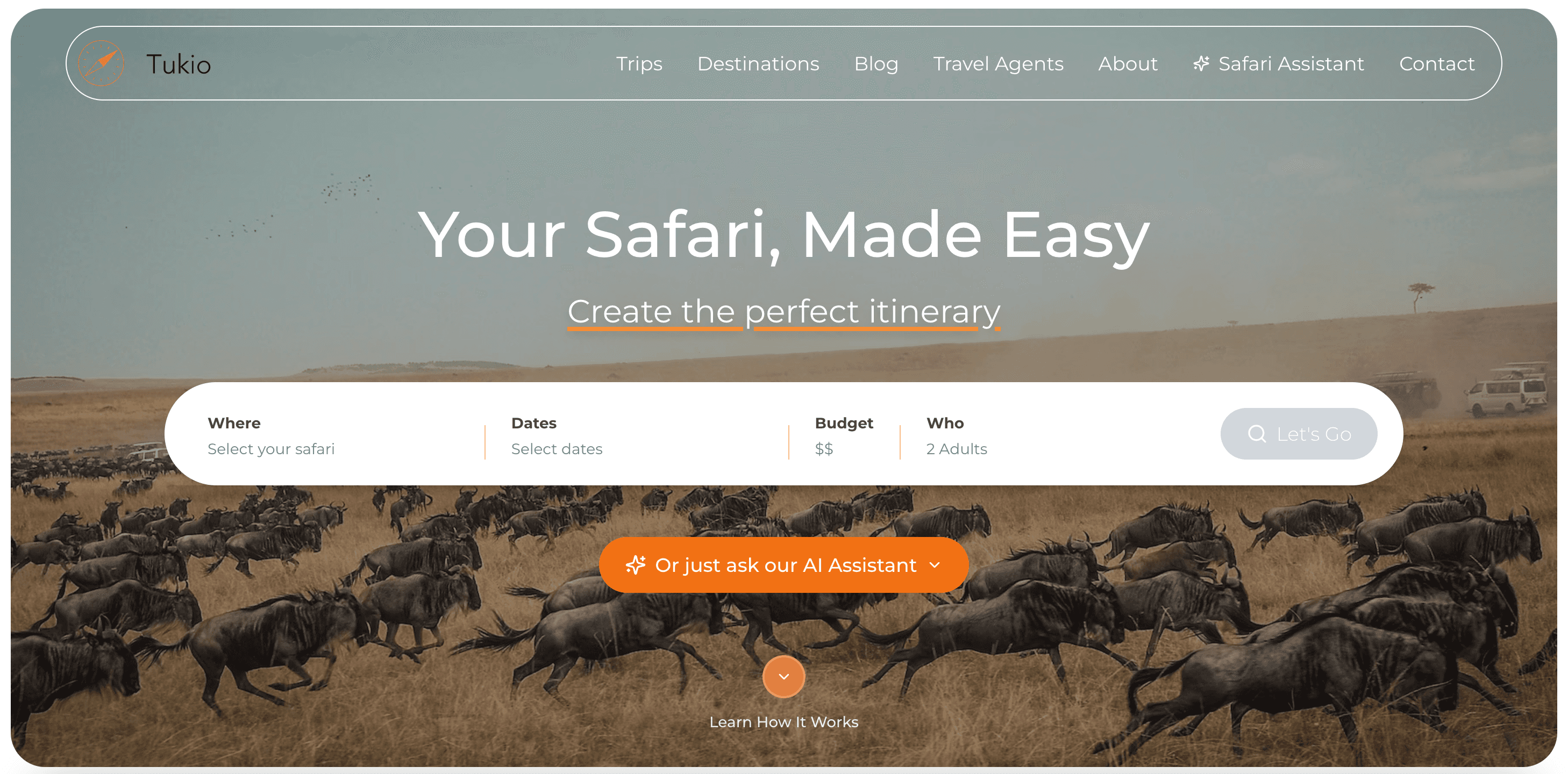
Yes. Most high-quality platforms allow fully customized itineraries often more flexibly than booking individual lodges separately. Most platforms will ask you to submit an inquiry and get back to you, while platforms like Tukio allow you to customize your itinerary directly on the platform.
Read more about safari booking platforms in our detailed guide.
Final Verdict: Direct or Platform?
There is no one-size-fits-all answer.
Booking direct works best for:
Single-camp stays
Repeat visitors
Self-drive safaris in places like Kruger National Park
Booking through a platform makes more sense for:
First-time safari travelers
Multi-destination itineraries
Complex logistics (like Okavango Delta fly-ins)
Gorilla trekking in Bwindi Impenetrable National Park
For most mid to high-end safaris, the price difference is negligible but the coordination, protection, and flexibility can be significant.
The smartest move?
Choose the booking method that matches the complexity of your itinerary and prioritize transparency, clear inclusions, and experienced on-ground support.
If you’re comparing options, start by seeing what a structured, transparent safari itinerary looks like and then compare it to booking each piece individually. The difference is often clearer than you expect.
Join the GoTukio Travel Club!
Receive exclusive inspiration and deals for your next trip.